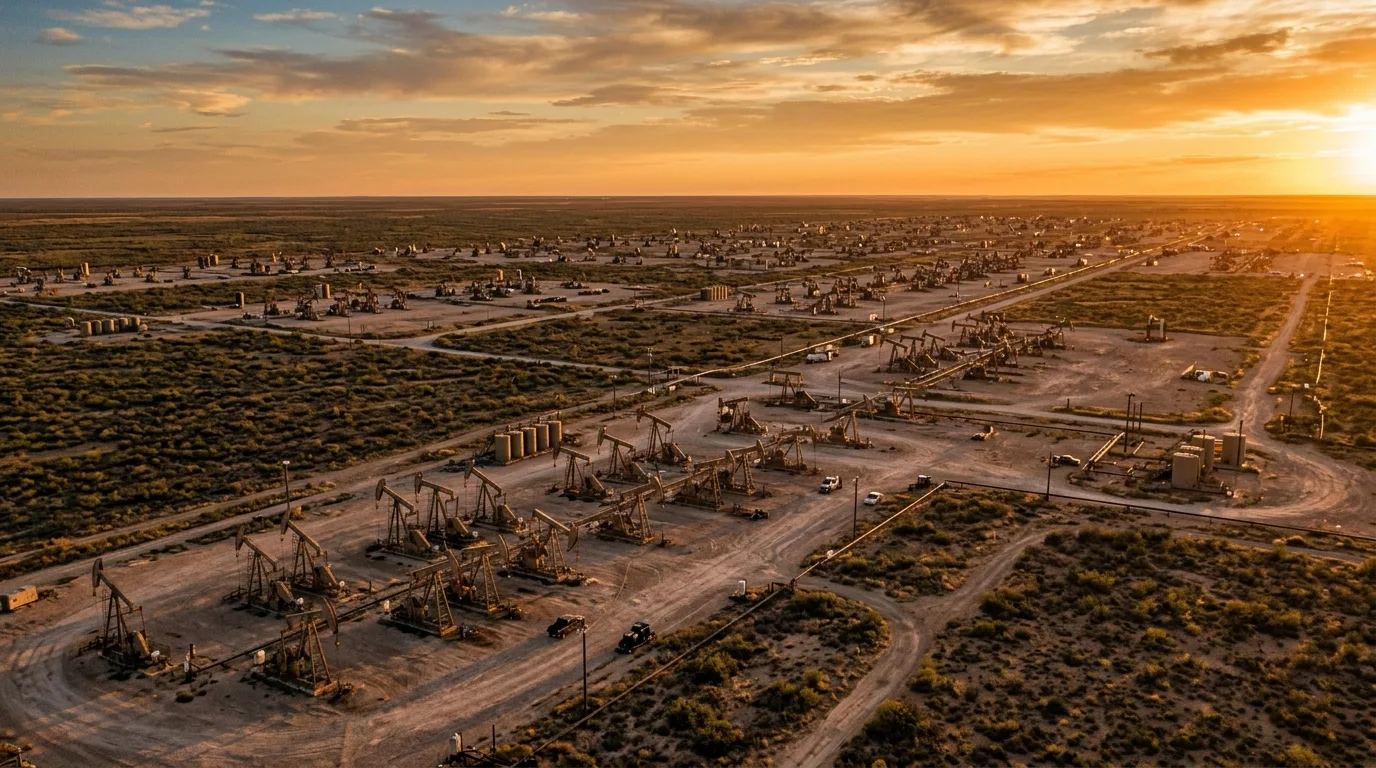
The onshore oil and gas industry that exists today looks fundamentally different from what it was thirty years ago. The formations being drilled are often the same ones that earlier operators tapped with vertical wells -- the Permian Basin, the Anadarko Basin, the Haynesville Shale across Louisiana and East Texas. What has changed is the technology used to access those formations and the volume of subsurface data available to support drilling decisions.
This article covers the key technologies that have reshaped onshore drilling: horizontal wellbore construction, hydraulic fracturing as a completion method, and the measurement-while-drilling and logging-while-drilling tools that allow engineers to make decisions in real time from thousands of feet below the surface.
From Vertical to Horizontal: Why the Shift Happened
Conventional vertical drilling worked well in formations where hydrocarbons accumulated in porous, permeable reservoirs. When you drill into a thick, high-porosity sand or carbonate, the well naturally contacts a productive column of rock and fluids flow to the wellbore under pressure.
The problem with vertical drilling in tight or shale formations -- low-permeability rocks where oil and gas are distributed throughout the matrix rather than concentrated in a discrete reservoir -- is contact area. A vertical well passing through a 50-foot shale interval contacts 50 linear feet of productive rock. Hydrocarbons may be present in abundance, but the flow path from rock to wellbore is too restricted for economic production.
Horizontal drilling solves this by turning the wellbore. Instead of drilling straight down through the target formation, the drill bit is deflected using downhole motors and steerable tools until the wellbore runs parallel to the formation, sometimes for several thousand meters. A well that traverses 4,000 meters of lateral distance through a tight formation contacts 4,000 meters of productive rock rather than 50. That is the core arithmetic of why horizontal wells in shale and tight sand formations produce far more than vertical wells in the same rock.
According to analysis of current drilling trends, more than 70 percent of new wells drilled in the United States today are horizontal, according to GET Global Group's drilling technology overview. The economics of horizontal wells in tight formations are well established: while a horizontal well can cost two to three times as much as a vertical well in the same area, production rates are frequently 10 to 20 times higher, as noted by Venergy Momentum's analysis of conventional versus unconventional drilling.
Directional Drilling Mechanics
Executing a horizontal well requires precise control over wellbore trajectory through three sequential phases. The vertical section uses conventional drilling to reach target depth. The build section -- the curve -- deflects the bit from vertical to horizontal using downhole motors and rotary steerable systems (RSS), typically over several hundred meters. The rate of angle change must stay within limits that allow casing installation. The lateral section runs horizontally through the target formation; modern shale wells commonly drill laterals exceeding 3,000 meters, with extended-reach designs reaching 4,500 to 5,000 meters. Longer laterals create more reservoir contact and, combined with multi-stage hydraulic fracturing, produce more hydrocarbons per well.
Hydraulic Fracturing as Completion Method
Drilling the horizontal wellbore is only part of the process. In tight formations with very low natural permeability, hydrocarbons will not flow to the wellbore in economic quantities without additional stimulation. Hydraulic fracturing creates the flow paths that make production possible.
After the lateral is drilled and cased, the completion crew pumps high-pressure fluid -- typically a mixture of water, sand, and chemical additives -- into discrete sections of the wellbore. The pressure is sufficient to crack the surrounding rock, creating fracture networks that extend outward from the wellbore into the formation. Sand proppant, carried in the fluid, lodges in the fractures and holds them open after pumping stops.
A multi-stage completion divides the lateral into segments, each hydraulically fractured in sequence from the toe of the well back toward the surface. A well with 50 frac stages has created 50 separate stimulated zones along the lateral, each contributing flow to the wellbore. The number of stages, spacing, fluid volume, and proppant loading are all engineering variables that operators optimize based on formation characteristics and offset well data.
The pairing of horizontal drilling and multi-stage hydraulic fracturing has unlocked formations that were uneconomical under conventional vertical drilling. The Anadarko Basin alone, which covers approximately 50,000 square miles across western Oklahoma and the Texas Panhandle, holds estimated unconventional technically recoverable resources of 16 billion barrels of oil and more than 200 trillion cubic feet of gas, according to IHS Markit research cited by Oklahoma Minerals. Much of this potential is accessible only through horizontal drilling and hydraulic fracturing.
Measurement While Drilling and Logging While Drilling
Drilling a horizontal well that stays precisely within a target formation -- which may be only a few meters thick -- requires continuous real-time information about where the drill bit is and what rock surrounds it. Two complementary technologies provide this information.
Measurement While Drilling (MWD) delivers directional and mechanical data from sensors built into the bottom-hole assembly (BHA). MWD measures the wellbore's inclination (angle from vertical), azimuth (compass direction), and real-time drilling parameters including downhole weight on bit, torque, temperature, and pressure. This data is transmitted to the surface using mud pulse telemetry -- pressure pulses encoded in the drilling fluid -- allowing directional drillers to steer the well continuously. Per SLB's MWD services overview, modern MWD systems support continuous survey updates that minimize invisible lost time and prevent rate-of-penetration limitations caused by data transmission gaps.
Logging While Drilling (LWD) adds formation evaluation to the real-time data stream. LWD tools positioned near the drill bit measure gamma ray response (which identifies rock type), resistivity (which indicates fluid content), density, and porosity. These measurements allow geologists to determine in real time whether the wellbore is in productive reservoir rock or has wandered into non-productive zones.
The combination of MWD and LWD enables geosteering -- actively adjusting the wellbore trajectory based on formation data to keep the drill bit in the most productive interval of the target formation. In thin, laterally discontinuous reservoirs, geosteering can make the difference between a well that stays in the sweet spot for most of its lateral length and one that loses the productive zone partway through drilling.
According to SMKST Petro's technical comparison of MWD and LWD, the two systems function as complementary intelligence: MWD provides the engineering data needed for steering decisions, while LWD provides the geological data needed for reservoir characterization and production forecasting.
Subsurface Data and Drilling Efficiency
Modern onshore operators enter every program with a substantial foundation of subsurface data. Three-dimensional seismic surveys image the subsurface by recording how sound waves reflect off underground rock layers, allowing geophysicists to map formation geometry, fault systems, and structural traps across large areas. In basins with decades of production history, seismic is supplemented by logs and production records from thousands of existing wells -- each one adding a data point that refines the geological model.
The technology-driven efficiency gains in onshore drilling are measurable. Drill times for comparable wells have decreased as operators refined procedures and accumulated operational experience on specific rigs and in specific formations. Proppant loading per lateral foot has increased in many plays as production data confirmed that more aggressive stimulation improved recovery. These efficiency gains affect working interest economics directly: lower well costs improve the ratio of deductible drilling expenses to expected production revenue, and stronger initial production rates increase the economic weight of the early high-volume period in the well's decline curve.
The cost structure of a horizontal completion -- a high proportion of intangible drilling costs, significant tangible equipment in the completion string -- also maps directly onto the tax provisions covered in Tax Advantages of Domestic Oil and Gas Investments.
Technology as an Operator Differentiator
Technology access is largely commoditized in the oilfield services market -- MWD/LWD tools, horizontal drill bits, frac pumping capacity, and 3D seismic data are available to operators across the size spectrum. What differentiates operators is how effectively they deploy this technology in a specific basin and formation.
Experienced operators develop completion designs refined through their own well data, build field service relationships that improve rig availability, and maintain geological models that identify productive acreage before market-wide recognition. These capabilities compound across drilling cycles. Operator evaluation -- covered in How Direct Participation Programs Work in Oil and Gas -- should focus on basin-specific track record rather than general industry credentials for this reason.
Summary
Horizontal wellbore construction, multi-stage hydraulic fracturing, and real-time MWD/LWD measurement systems are the three interlocking technologies that have reshaped onshore oil and gas drilling. Together, they have expanded the productive resource base of established domestic basins, reduced geological uncertainty through better subsurface imaging and real-time formation evaluation, and created a competitive landscape in which operator expertise translates directly into well performance.